You do not need to master the whole healthcare system—only a reliable route through it.
Choose the Right Door Before You Book the Flight
Most international patients start by asking which hospital in China is the 'best'. That is the wrong first question, because the answer depends on the condition, not the reputation. In practice you will choose among four doors. A large public tertiary hospital offers the broadest specialties, the most experienced clinicians and comparatively low fees, but it is crowded and heavily digital. An international or VIP department inside that same hospital keeps the hospital's resources while adding language support and a calmer process at a higher price. A private international hospital is easiest for English speakers and may bill insurers directly, but costs can approach private care in Europe. A community clinic is fine for a minor problem and wrong for anything serious.
The practical rule is simple: match the door to the condition. Use a convenient clinic for a straightforward issue, a major hospital for anything serious or complex, and an international department when communication and continuity matter more than saving money. Before you commit, confirm in writing that the specific department treats your condition and is open, because an international department is not an emergency room and a famous hospital may not be the right campus for your specialty.
Make the Medical File the First Deliverable
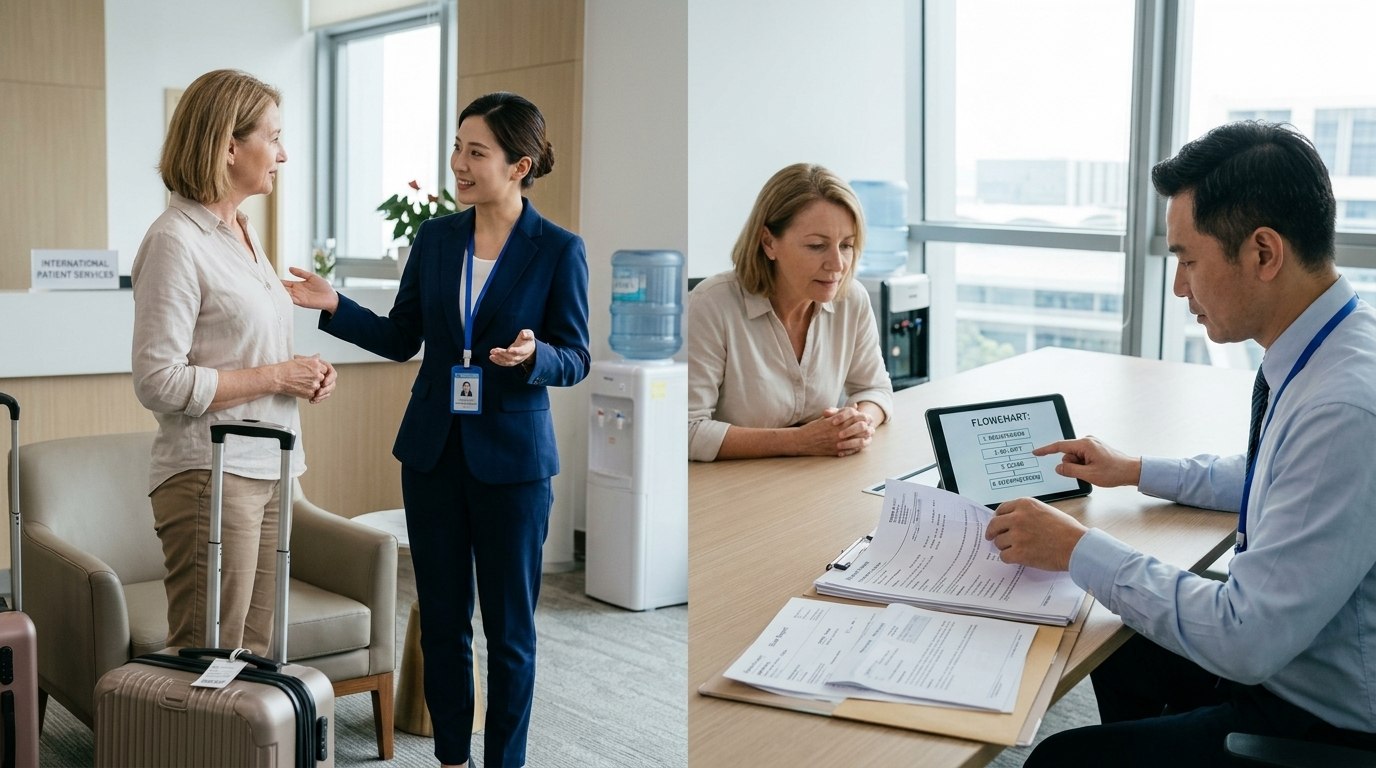
Your medical file, not your plane ticket, is the first thing a receiving hospital actually needs. A hospital can only answer your question if it can read your history quickly. Start with a one-page summary that states the working diagnosis, the main symptoms and their timeline, previous treatment, current medicines with generic names, allergies and the exact question you want answered. Then attach the evidence in a predictable order: recent consultation and discharge summaries, pathology reports, laboratory results, procedure records and imaging reports.
For CT, MRI or PET studies, keep the original DICOM files alongside the written report; photographs of a screen are rarely an adequate substitute. Remove duplicate pages, label every file with its date and body site, and add a short index. Anything not in English or Chinese should be translated into one of those two languages, and uncertainty must be preserved honestly: suspected, indeterminate and cannot exclude must never be silently upgraded to confirmed.
Verify Entry Requirements Through the Right Authority
Visa and entry rules change and vary by nationality, so confirm them only through the relevant Chinese embassy, consulate or immigration authority. A patient-coordination service can help prepare appointment letters and organize records, but it cannot issue or guarantee a visa, and it cannot promise entry. Anyone who offers a guaranteed visa for a fee is not describing how Chinese entry rules actually work.
Carry, both on your person and digitally, your passport, appointment details, the hospital and hotel addresses written in Chinese, your return or onward travel information and your essential medical documents. Save your home address in Chinese in your phone. These are small preparations that cost nothing and save the most time in a stressful moment.
Plan Money for the Real Shape of a Hospital Bill
Chinese hospitals typically charge at several points during a single visit, not once at the end. Expect separate payments for consultation, tests, imaging and pharmacy, and be ready to pay as you go. Common methods are RMB cash, UnionPay and mobile payment; international departments may accept major international cards. Direct billing is not automatic — it depends on a current agreement between the hospital and your insurer, and pre-authorization may be required.
Keep two documents everywhere you go: the official fapiao (invoice) and an itemized bill. Together with the medical record and prescriptions, these are what an insurer actually needs for reimbursement. Ask for them at every step rather than trying to reconstruct them at the end, and separate your coordination and travel costs from hospital charges so you always know what each yuan was for.
Build the First Days Around the Hospital
Plan your first days around the hospital, not tourism. Allow time for rest, registration, translation, pathology review and repeat tests, and stay within practical reach of the correct campus — Chinese hospitals sometimes run several campuses, and the right gate is not always the famous one. For any consultation that touches on consent, surgery, medication changes or a serious diagnosis, a professional medical interpreter is worth far more than a translation app or a well-meaning friend.
During each visit, repeat the plan back in your own words before you leave: the diagnosis or working diagnosis, the tests ordered, the medicines and doses, the warning signs to watch for and the next review date. This single habit catches misunderstandings on both sides while there is still time to correct them.
End With a Documented Handover
A medical journey does not end at the airport. Before you leave, collect consultation notes, test results, prescriptions, discharge documents, invoices and digital copies of imaging where available. Confirm the warning signs to watch for, medication instructions, travel restrictions and the date of the next review. The strongest ending is a documented handover: a clear statement of who will communicate with the hospital after you leave and how results will reach your doctor at home.
If you remember only one habit from this guide, make it this: verify the follow-up plan in writing before you leave the building. You do not need to master the entire Chinese healthcare system. You need a reliable route through it, and once that route is mapped, seeking treatment in China becomes less like entering a maze and more like following a well-marked path.
Practical note
This article provides general orientation, not medical advice. Hospital services, booking channels, prices and insurance arrangements change by city and institution. Verify urgent-care capability and payment rules directly with the hospital and insurer.
Official references
- Medical Guide for Foreigners in BeijingBeijing Municipal Government · Accessed October 12, 2026
- Entry, exit and visa informationNational Immigration Administration of China · Accessed October 12, 2026
- Common procedures for seeing a doctor at Chinese hospitalsNational Health Commission of China · Updated March 5, 2019
- The First Affiliated Hospital, Sun Yat-sen University — international servicesFAH–SYSU · Accessed October 12, 2026

 WeChat: sj42871