You do not need to master the whole healthcare system—only a reliable route through it.
Why 2026 Is a Different Conversation
Inbound medical care in China has shifted from a niche topic into a mainstream one. The reasons are practical rather than promotional: China now holds a growing share of the world's newest medical approvals, its public hospitals run at a scale and speed that most systems cannot match, and its costs for many procedures remain materially lower than in North America or Western Europe. For an international patient, none of this matters unless the route into the system is clear. That is what this guide is for.
The single most important thing to understand is that there is no single foreigner pathway. What works in Shanghai is not identical to Guangzhou, and a private international clinic is a different product from the international department of a large public hospital. The goal of planning is not to memorize the whole system. It is to pick one reliable route and stay on it.
The Real Decision: Which Door You Use
Most international patients end up choosing among four doors. A large public hospital offers the broadest specialties, the most experienced clinicians and comparatively low fees, but it can be crowded and digital-first. An international or VIP department inside that same public hospital keeps the hospital's resources while adding language support and a calmer process — at a higher price. A private international hospital is the easiest for English speakers and may bill insurers directly, but costs can approach private care in Europe. A community clinic is fine for minor problems but not for a serious or complex condition.
A useful rule of thumb: match the door to the condition. Use a convenient clinic for a straightforward issue, a major hospital for anything serious, and an international department when communication and continuity matter more than saving money. Confirm before you travel that the specific department treats your condition and is open — an international department is not an emergency room.
Paperwork Comes Before the Plane Ticket
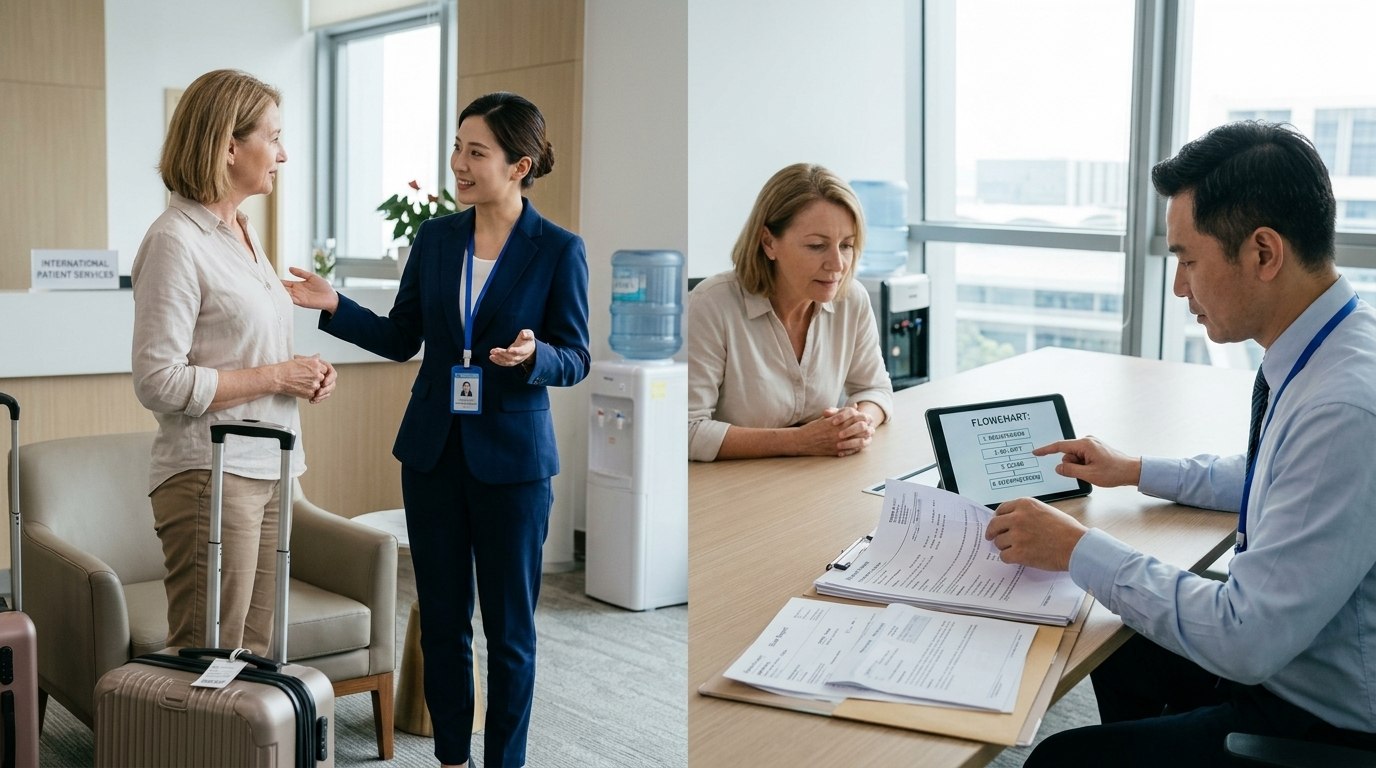
The medical file, not the flight, is the first deliverable. A well-prepared case summary lets a hospital tell you, before you spend anything on travel, whether your case is even suitable for assessment. The essentials are: a one-page summary of the diagnosis and the question you want answered; recent pathology and imaging reports; laboratory results; a current medication list with generic names; and, if you have CT, MRI or PET imaging, the original DICOM files rather than screenshots.
Dates matter more than patients expect. Arrange documents from newest to oldest, and have anything that is not in English or Chinese translated into one of those two languages. A coordinator can structure this into a package a Chinese physician can actually read, but the raw material has to come from you. The clearer the file, the faster a hospital can answer.
Entry, Visas and What a Coordinator Cannot Do
Visa and entry requirements change and vary by nationality, so verify them only through the relevant Chinese embassy, consulate or immigration authority. A patient-coordination service can help prepare appointment letters and supporting records, but it cannot issue or guarantee a visa. Anyone who promises otherwise is not being honest with you.
Carry, both on your person and digitally: your passport, appointment details, the hospital and hotel addresses in Chinese, your return or onward travel information, and your essential medical documents. Keep your home address in Chinese saved in your phone — it is the detail that saves the most time in a stressful moment.
Money: Plan for the Real Shape of a Hospital Bill
Chinese hospitals typically charge at several points during a single visit, not once at the end. Expect separate payments for consultation, tests, imaging and pharmacy, and be ready to pay as you go. Common methods are RMB cash, UnionPay and mobile payment; international departments may accept major international cards. Direct billing is not automatic — it depends on a current agreement between the hospital and your insurer, and pre-authorization may be required.
Keep two documents everywhere you go: the official fapiao (invoice) and an itemized bill. These, together with the medical record and prescriptions, are what an insurer actually needs for reimbursement. Ask for them at every step rather than trying to reconstruct them at the end.
The First Days: Build Them Around the Hospital
Plan your first days around the hospital, not tourism. Allow time for rest, registration, translation, pathology review and repeat tests, and stay within practical reach of the correct campus — Chinese hospitals sometimes have several campuses, and the right gate is not always the famous one.
For any consultation that touches on consent, surgery, medication changes or a serious diagnosis, a professional medical interpreter is worth far more than a translation app or a well-meaning friend. Precision matters in medicine, and this is the one place where cutting costs tends to cost more later.
Aftercare: The Journey Ends With a Handover
A medical journey does not end at the airport. Before you leave, collect consultation notes, test results, prescriptions, discharge documents, invoices and digital copies of imaging where available. Confirm the warning signs to watch for, medication instructions, travel restrictions and the date of the next review.
The strongest ending is a documented handover: a clear statement of who will communicate with the hospital after you leave, and how results will reach your doctor at home. If you remember only one habit from this guide, make it this one — verify the follow-up plan in writing before you leave the building.
Practical note
This article provides general orientation, not medical advice. Hospital services, booking channels, prices and insurance arrangements change by city and institution. Verify urgent-care capability and payment rules directly with the hospital and insurer.
Official references
- Medical Guide for Foreigners in BeijingBeijing Municipal Government
- Entry, exit and visa informationNational Immigration Administration of China
- National health plan for 2026–2030 (AI and connected medical records)The State Council of China
- China approves world's first implanted brain-computer interface deviceWuhan Science and Technology Innovation Bureau
- Domestic surgical robots draw level with the da Vinci systemShandong Finance News

 WeChat: sj42871